2026-09-04 · Jason Clearwater
Why Fort Worth AC Units Freeze During Summer Heat Waves
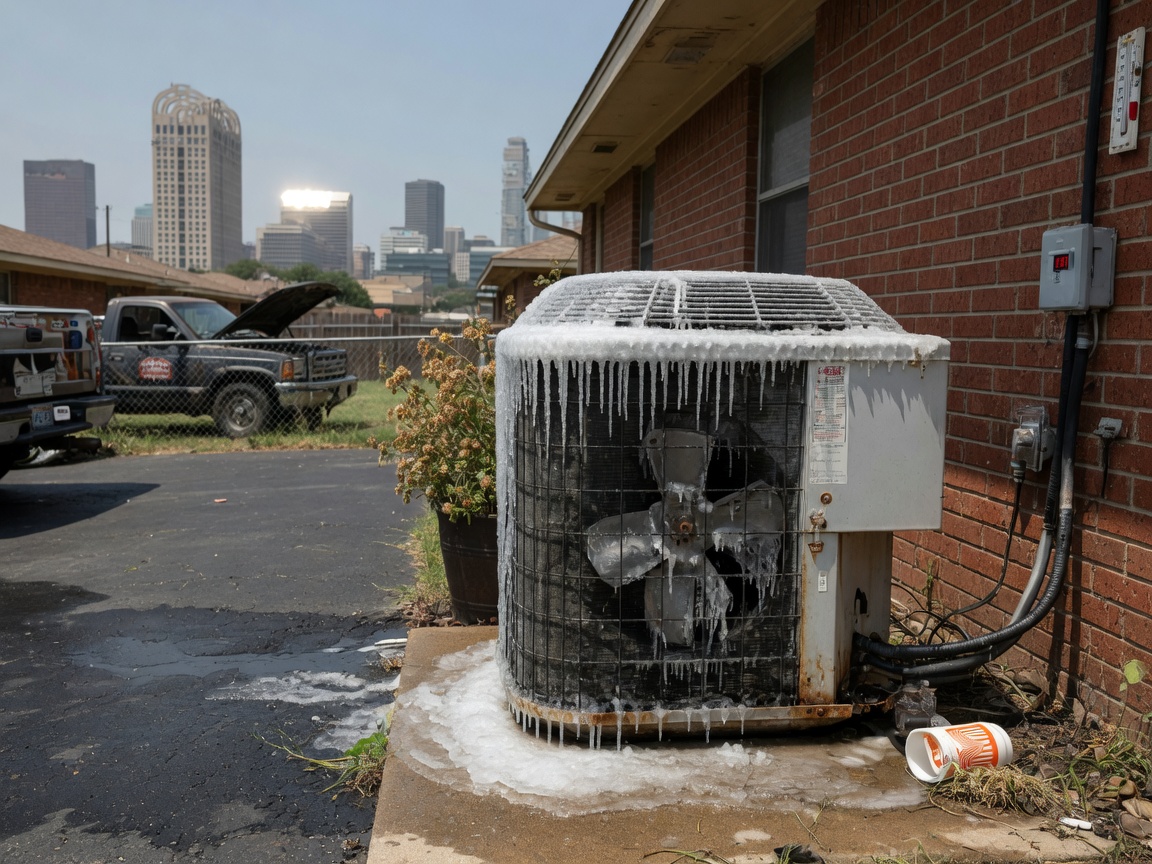
Fort Worth AC units freeze during summer heat waves primarily because restricted airflow or low refrigerant prevents the evaporator coil from absorbing enough heat, causing temperatures to drop below 32 degrees and ice to form even when outdoor highs exceed 100 degrees.
Restricted Airflow from Local Pollen and Dust
Fort Worth sits in a humid subtropical zone where summer pollen from surrounding prairie grasses combines with construction dust from ongoing development in Tarrant County to clog filters faster than in drier regions. Homes in the Cultural District and Arlington Heights, many built before 1970 with original ductwork, trap this fine particulate in return vents, cutting airflow by enough to drop coil temperatures sharply. When a system runs continuously to combat 100-degree afternoons, any further reduction in air movement turns condensation into ice within hours. Residents near the Kimbell Art Museum often notice the issue first because mature trees add extra organic debris to the mix. Checking and replacing filters every three weeks during July and August prevents most of these freezes without a service call.
Low Refrigerant Levels in Older Tarrant County Homes
Many homes around TCU Stadium and the Stockyards still use systems installed 15 to 20 years ago that develop slow leaks at flare fittings or evaporator coils. In Fort Worth's mild winters the systems rarely run long enough to reveal these leaks until summer heat waves force 18-hour run times. A unit that has lost even 20 percent of its charge will freeze the coil while the outdoor condenser labors to keep up. Technicians working calls in Downtown Fort Worth report that systems in 1950s bungalows show this pattern more often because the original copper lines were never replaced during past renovations. Regular pressure checks during AC Service catch these losses before a heat wave arrives.
Rapid Temperature Swings and Thermostat Settings
Fort Worth experiences sharp evening drops after triple-digit days, especially near Sundance Square where concrete retains heat longer than surrounding neighborhoods. Homeowners who leave the thermostat at 72 degrees overnight force the system to short-cycle when outdoor air cools, allowing moisture on the coil to freeze instead of draining. Linking the thermostat to outdoor sensors or following guidance in Adjusting Your Thermostat Settings for Fort Worth's Rapid Temperature Swings reduces these cycles. In Mansfield and Keller, where newer subdivisions have tighter envelopes, the same setting can produce ice because the house retains cool air too well and the system never reaches a proper off cycle.
How Humidity and Coil Condition Interact
The region's typical 60 to 70 percent relative humidity during July afternoons means the evaporator coil already carries a heavy condensate load. When pollen or dust from How Local Pollen and Dust Affect Fort Worth Air Filter Replacement Schedules further insulates the fins, heat transfer drops and the coil surface temperature falls below freezing even though the thermostat still calls for cooling. Systems serving single-story ranch homes in Southwest Fort Worth suffer more because longer duct runs lose static pressure faster once filters load. Cleaning the coil with a no-rinse solution and verifying blower speed settings restores proper heat absorption without adding refrigerant.
Practical Steps During a Heat Wave Freeze
Shut the system off at the thermostat and switch the fan to ON so warm indoor air melts the ice within two to four hours. Never chip at the ice or run the unit while frozen, as this can bend fins or damage the compressor. Once thawed, replace the filter and check that all supply vents remain open, especially in second-floor rooms of two-story homes near the TCU area. If the unit freezes again within 48 hours, schedule AC Repair rather than adding refrigerant yourself, because the underlying airflow or charge issue will repeat during the next stretch of 100-degree days common in East Fort Worth.